
Home / Practice Areas / Social Security Disability / SSDI
Since 1953
Serving Ohio's Disabled
100+ Years
Combined Experience
4 Ohio Offices
Statewide Reach
No Fees
Unless We Win
What Is Social Security Disability Insurance (SSDI)?
Social Security Disability Insurance (SSDI) is a federal program that pays monthly benefits to people who can no longer work because of a disability and who earned enough work credits by paying Social Security taxes. It is run by the Social Security Administration.
The simplest way to understand SSDI: you paid in, so you are insured. With every paycheck, you funded Social Security and earned work credits. If a disability later stops you from working, those credits make you eligible for SSDI benefits. In Ohio, the Bureau of Disability Determination reviews your medical file and decides whether your condition meets Social Security's rules.
Here is the hard part: most first claims are denied. About two out of three Ohio applications are turned down the first time, often for missing medical evidence or paperwork errors. A denial is not the end, but the deadlines are short, and the appeal is where strong cases are won.
Should You File for SSDI or SSI?
If you worked and paid Social Security taxes, SSDI is usually your program. SSI is a separate, need-based program for people with little or no work history and limited income. Some Ohioans qualify for both.
The quickest way to tell them apart: SSDI is based on your work record, while SSI is based on financial need. If your work history is limited, SSI may be the better fit, and a "concurrent" claim can include both.
For a full side-by-side breakdown of both programs, see our Ohio Social Security Disability overview. If limited income and work history describe your situation, learn about SSI in Ohio.
Who Qualifies for SSDI in Ohio?
To qualify for SSDI in Ohio you need two things: enough recent work credits, and a medical condition that prevents substantial gainful activity for at least 12 months. In 2026, earning more than $1,690 a month generally counts as substantial gainful activity.
Work Credits & Date Last Insured
SSDI requires enough work credits, earned by paying Social Security taxes. Most adults need 40, with 20 in the last 10 years. If you stopped working years ago, you must prove your disability began before your "date last insured."
The Medical Standard (Blue Book)
Your condition must meet Social Security's medical standard. If it matches a listing in the SSA's "Blue Book," you may qualify. If not, you can still win by showing your residual functional capacity is too limited for full-time work.
Substantial Gainful Activity (SGA)
SGA is the income line for deciding if you are "working." In 2026, earning over $1,690 a month (more if blind) usually means you will not qualify. Earn under that, with a qualifying condition and enough credits, and your claim stays alive.
How Much Does SSDI Pay in Ohio?
SSDI payments are based on your lifetime Social Security earnings, not on your condition. In 2026, the average SSDI benefit is about $1,630 a month, and back pay can cover the months you waited for a decision.
Ohio SSDI by the Numbers (2026)
Average monthly SSDI benefit
$1,630
Maximum monthly SSDI benefit
$4,152
Substantial Gainful Activity (SGA) limit
$1,690/mo
2026 cost-of-living increase (COLA)
2.8%
Medicare eligibility
24 months
Attorney fee (from back pay)
25%, up to $9,200
Ohio state income tax on SSDI
None
2026 SSA figures (Social Security Administration cost-of-living data).
Amounts are reviewed annually.
Two things often surprise our clients. First, there is a six-month waiting period before benefits begin, but you can receive back pay for the months your approved claim was pending, sometimes a year or more.
Second, Ohio does not tax SSDI benefits, though a portion may be taxable at the federal level depending on your household income. If you also receive Ohio Medicaid, a back-pay lump sum can affect eligibility, so it is worth planning for.
Conditions That May Qualify for SSDI
SSDI is not limited to one type of condition. Physical illnesses, injuries, and mental-health conditions can all qualify if they meet Social Security's medical standards and keep you from working full time.
Musculoskeletal & Back
Degenerative disc disease, spinal injuries, severe arthritis, and joint conditions that limit movement or lifting.
Cancer
Many cancers qualify, and some aggressive forms qualify quickly under expedited rules.
Mental-Health Conditions
Depression, anxiety, PTSD, and bipolar disorder, when documented by ongoing treatment records.
Respiratory Conditions
COPD, severe asthma, and other chronic breathing disorders.
Neurological Disorders
Multiple sclerosis, epilepsy, Parkinson's disease, traumatic brain injury,
and stroke.
Autoimmune Disorders
Lupus, rheumatoid arthritis, and related inflammatory diseases.
Cardiovascular Disease
Heart failure, coronary artery disease, and other conditions limiting exertion.
Long COVID & Chronic Illness
Newer conditions can qualify when records show lasting, work-
limiting effects.
How to Apply for SSDI in Ohio (and Appeal a Denial)
Applying for SSDI in Ohio starts with a claim to the Social Security Administration. Because most first claims are denied, the appeal process matters just as much. There are four stages, each with its own deadline.
Application
File with complete medical evidence and work history. Thin records cause
most denials.
Reconsideration
The first appeal after a denial. You have 60 days to strengthen your file.
ALJ Hearing
Your case goes before a judge, where approval odds rise and an attorney
matters most.
Appeals Council
Review of an unfavorable decision, with federal court as the final step.
How an Ohio SSDI Attorney Helps Your Claim
An Ohio SSDI attorney builds the medical evidence, meets every deadline, and represents you at the hearing where most claims are won. Knisley Law handles every stage of your SSDI claim, and you pay no fee unless we win.
Filing & Strengthening Your Application
We get the foundation right: your onset date, complete medical records, and a careful check of your work credits and date last insured. A well-built application avoids the errors that sink so many
first claims.
Representing You at the ALJ Hearing
The hearing before an Administrative Law Judge is where strong cases are won. We prepare your testimony, line up vocational and medical expert opinions, and present a clear picture of why you cannot work full time.
Appealing a Denial
A denial is not a verdict. It is the start of the appeal. At reconsideration, we strengthen your medical record and fix the gaps that led to the denial, rather than filing the same claim again.
When to Call an Attorney
Sooner is better. The deadlines are short, the medical evidence has to be right, and the strongest claims are built from the start. If you are about to apply, or you just received a denial, that is the time to call.
SSDI and Ohio Workers' Compensation: The Offset
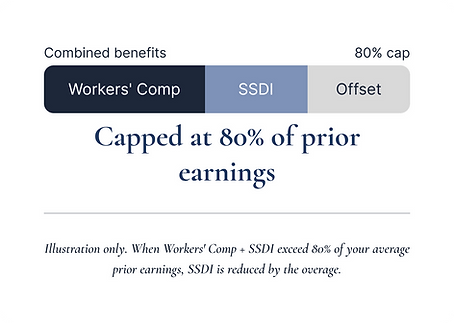
If you receive both SSDI and Ohio Workers' Compensation, the combined amount cannot be more than 80% of your average prior earnings. When the total goes over that cap, Social Security reduces your SSDI to bring it back under. This is the "Workers' Compensation offset."
The offset trips up a lot of disabled Ohioans, because a Workers' Comp settlement can quietly cut your SSDI check if the claims are not coordinated. How a settlement is written, and how the language is structured, can change how much offset applies.
A firm that handles both SSDI and Ohio Workers' Compensation can plan your claims together to protect as much of your monthly benefit as possible. Because Knisley Law has represented injured and disabled Ohioans since 1953, we see how these two systems interact every day.
Why Ohioans Choose Knisley Law for SSDI
Three Generations of Knisley Attorneys
Founded in 1953 and now in its third generation, our firm brings more than 100 years of combined experience to Ohio disability claims. Doug Knisley alone has practiced for over 40 years.
Deep Roots in Ohio's Benefits System
The Knisley family's ties to Ohio's disability and Industrial Commission history go back generations. We know how the state's systems actually work, and we use that to build stronger claims.
Help Across Ohio, However You Prefer
From offices in Columbus, Chillicothe, Lima, and Newark, we meet clients by phone, video, or in person, wherever you are in the state.
Frequently Asked Questions About SSDI in Ohio
